By Neill Simmons
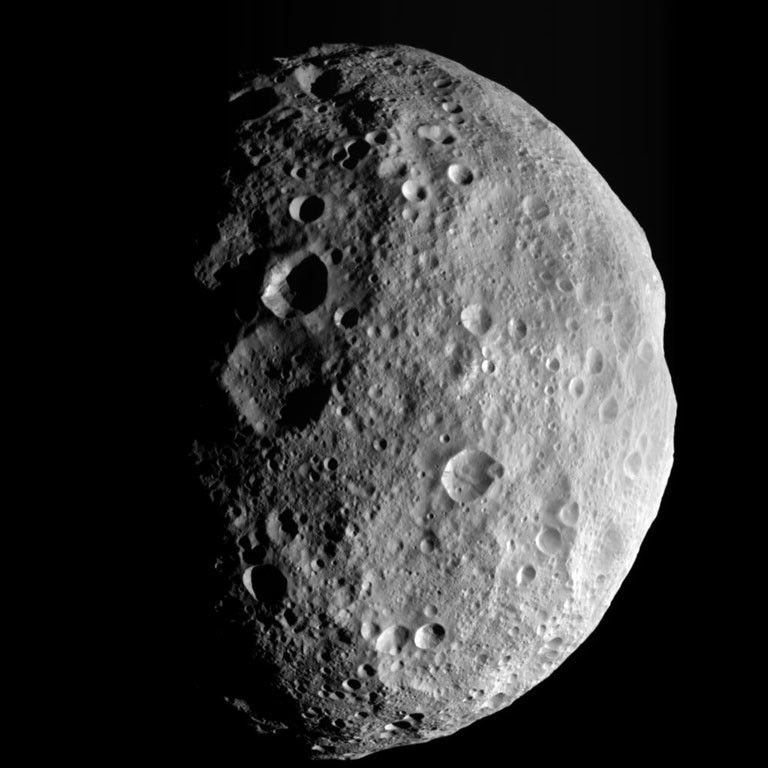
The highlight of May is a very rare event starting on Thursday, May 1. The second biggest asteroid, named Vesta, shows up in our night sky. It has a diameter of 326 miles and is one of the brightest asteroids. Vesta is also “differentiated,” meaning it has a crust, mantle, and core, similar to terrestrial planets like Earth. It will be located in the south within the constellation of Libra and then travels through the constellation of Virgo. Binoculars will greatly help to spot Vesta.
Griffith Park Observatory will have it’s monthly Star Party on Saturday evening, May 3, and will have over 50 telescopes on the front lawn. Many of these will be focused on the Vesta asteroid. This is a FREE event!
Sunday night, May 4, will bring a beautiful crescent Moon. Look low in the west and it will be next to the planet Jupiter. Enjoy this event as Jupiter will be leaving the night sky in June. Jupiter is the largest planet in our Solar System with 79 known moons. The four largest moons are Europa, Io, Ganymede, and Callisto. Jupiter is composed mainly of hydrogen and helium gases and have no solid surface. Jupiter’s visible bands are colder than the rest of the planet.
Monday night, May 5, the Eta Aquarids meteor shower will occur. The best chance to see meteors will be in the early morning hours of May 6, when the Moon is below the horizon. A “fireball” occurs when the meteor is large enough and fast enough to last at least four seconds before burning up in the Earth’s atmosphere.
On May 12, the full “Flower Moon” will appear. The Flower Moon is named after the abundant flowers that grow in the Northern Hemisphere in May. The moon is slowly drifting away from our planet by about 1.5 inches (4 centimeters) per year. While this isn’t much, it will cause the moon to become notably more distant from Earth over millions of years. The Moon is a dusty ball of rock, roughly a quarter of the size of Earth. Its surface is made up of huge craters, large mountains, and flat planes call “seas” which are made up of hardened lava.
Each night in May, look high in the west to spot the constellation Gemini’s twin bright stars, Castor and Pollux. Close by the red planet, Mars, will be visible. At this time, Earth is pulling away from Mars which causes Mars to appear dimmer. Also each night, the giant constellation of Leo the Lion will be straight up.
The Big Dipper, one of our favorite star patterns, will be high in the north. It is part of the Ursa Major Constellation, which is the third largest constellation in the sky. Its brightest star, Alioth, is over 100 times brighter than our Sun. The Big Dipper has been used as a navigational tool for centuries as two of its stars function as pointers to the North Star. The North Star, located in the Little Dipper, is the only star in the sky that does not move.
Dawn Patrol: The planet Venus is putting on a show in the early morning from 4:30 am until sunrise. Venus is the second planet from the Sun and is known as Earth’s “sister planet” due to similar size and mass. It’s a rocky, terrestrial and is the hottest planet in our solar system, with a surface temperature hot enough to melt lead. It is the third brightest object in the sky after the Sun and Moon, making it easily visible from Earth.
When not stargazing, Neill Simmons is a Wealth Advisor with LPL Financial in Woodland Hills. If you have any astronomy or financial questions, he may be reached at (818) 936-2626 or emailed at at neill.simmons@lpl.com.