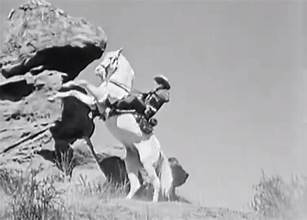
My good friend Roger Carroll, one of the disc jockeys on the late KMPC radio station (which Autry owned), introduced me to Gene, and the singing cowboy was as gracious as could be. We invited him to join us for lunch, but he had to drive to Anaheim for a meeting with the California Angels baseball team management, a team he later bought.
Born Orvon Grover Autry in 1907, Autry became one of the biggest stars of the 1930s and 1940s. He starred in nearly 100 films, made hundreds of recordings, and later became one of television’s first Western heroes.
Gene Autry was not Hollywood’s first singing cowboy, but he transformed the singing cowboy into one of the most popular screen figures of the 1930s and 1940s. The first singing cowboy was Ken Maynard, who sang “The Lone Star Trail” and “The Cowboy’s Lament” in Universal’s The Wagon Master in 1929. While Autry sang dozens of songs in scores of films, his best-known were “Back in the Saddle Again,” “Here Comes Santa Claus,” “Rudolph the Red-Nosed Reindeer,” and “Peter Cottontail.”
Autry’s movie career began in 1934 with a small appearance in Old Santa Fe, produced by Mascot Pictures, whose Studio City complex later became Republic Pictures, and today’s Radford.
His connection with the San Fernando Valley became much deeper with The Phantom Empire (1935), Mascot’s 12-chapter serial combining cowboys, radio, robots, and an underground civilization. Much of its outdoor action was photographed at Chatsworth’s Iverson Movie Ranch.
For decades, Autry came home not to a ranch in Texas, but to one in Studio City, where he resided for more than 60 years. His association with the San Fernando Valley dates at least to 1940, when Gene and his first wife lived on Bluffside Drive in Studio City. Sadly, their home was destroyed by fire in November 1941.
During World War II, Autry served as a transport pilot flying hazardous missions carrying fuel, ammunition, and other supplies in the China-Burma-India theater.
When he returned to civilian life, Autry built another Studio City home. Completed about 1949, the estate on Brookdale Road in Fryman Canyon covered more than 3.5 acres and included an 8,000-square-foot main house, guesthouse, swimming pool, and gardens. It was his Los Angeles home during the years when he transformed from movie cowboy into business tycoon, and it was there that he died in1998.
Unlike most cowboy stars who reigned over the cinematic range the first 50 years of the past century, Autry was a remarkably shrewd businessman.
In 1951, he and a partner established Golden West Broadcasters, which accumulated radio and television properties, including KMPC, one of Los Angeles’ most important radio stations. Golden West acquired KTLA Channel 5 in 1964 for approximately $12 million. Autry sold the station to Tribune Broadcasting 18 years later for nearly $250 million.
He established music-publishing companies that controlled valuable compositions and created Flying A Pictures to produce television programs. Instead of accepting a performer’s paycheck, he sought ownership of the songs, programs, and businesses that generated those paychecks.
Autry purchased the roughly 110-acre Monogram Ranch in Placerita Canyon near Newhall in 1952–53 and renamed it Melody Ranch, filming his own television program there but also turning it into a thriving Western TV production center.
Other series using Melody Ranch included Hopalong Cassidy, The Cisco Kid, The Adventures of Wild Bill Hickok, The Lone Ranger, The Life and Legend of Wyatt Earp, Sheriff of Cochise and, most famously, Gunsmoke. The familiar Gunsmoke opening gunfight was filmed on the Western street there.
What’s striking is that most of his fortune did not come from being a singing cowboy. Autry turned his entertainment earnings into a diversified business empire that included radio and television stations, real estate and hotels, music publishing and copyrights, including rights associated with his enormous recording catalog, the California/Los Angeles/Anaheim Angels, which he acquired as an expansion franchise in 1961, oil interests, and other investments.
Forbes estimated his worth at least $150 million in 1984; by 1991 he was estimated at about $300 million. He was worth more than $320 million when he died on October 2, 1998; that is equivalent to more than $655 million today. Forbes had long ranked Autry among America’s wealthiest people.
Gene Autry remains the only entertainer to have five stars on the Hollywood Walk of Fame—one each for motion pictures, television, radio, recording and live performance.
Pretty good for a singing cowboy.
Martin Cooper supervised public relations for the Academy of Motion Picture Arts & Sciences for 10 years; held executive positions with Disney and Universal Studios; was Board Chairman of the UCLA Film & Television Archive; and is a member of the Board of the British Film Institute in America. He is currently writing the official history of the Hollywood Burbank Airport.