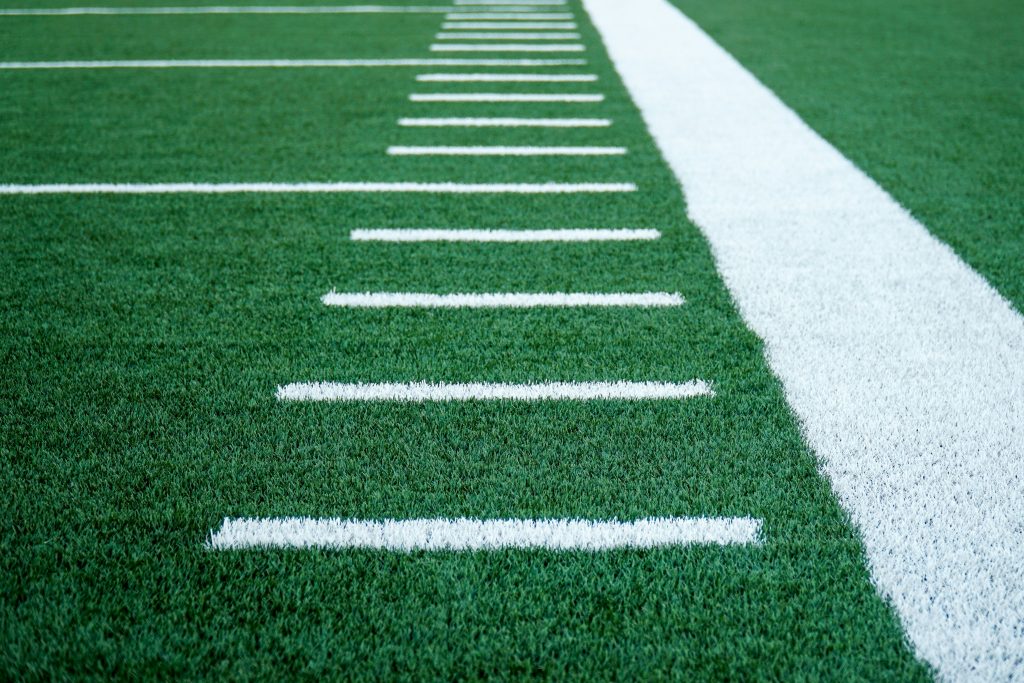
The Los Angeles Unified School District (LAUSD) is conducting a comprehensive Turf Study of natural grass and synthetic turf athletic fields at district high schools — examining long-term costs, environmental impacts, and health and safety considerations.
The LAUSD board already decided last November to ban installations of artificial turf in elementary and middle schools for health and safety reasons, but is still debating whether to allow it for higher-use high school athletic fields. They’ve engaged the consultant firm LPA (teamlpa.com) to gather information and community feedback about artificial turf and natural grass fields before making a final decision this summer. They’re currently holding community meetings to give a presentation about their findings on artificial turf and ask for input.
This decision is relevant for people beyond LAUSD stakeholders. Heat maps show how artificial turf fields at schools heat up the entire surrounding neighborhoods.
Artificial turf can create harmful local heat islands with very high field surface temperatures which range from 40 – 60 degrees F higher than natural grass – even with moderate air temperatures – causing poor athletic performance and heat related injury and illness, such as burns, heat stress, heat stroke and heat exhaustion, making the fields unusable. In contrast natural grass fields rarely get above 100 degrees F.
A recent UC Irvine study has been getting a lot of press; it found that there are extreme inequities in the temperatures of parks in different regions of LA, in large part due to the use of artificial turf in some parts of the city and not in others: publichealth.uci.edu/2026/04/07/mapping-urban-heat-from-space-reveals-dangerous-inequities-in-la-public-parks.
More than a third of parks and recreational spaces in South Los Angeles hit or exceeded the human thermal pain threshold, while no parks in West Los Angeles did.
Researchers determined that South Los Angeles parks were built with far more heat-retaining materials, such as artificial turf and concrete, than those in West Los Angeles.
This topic is particularly important for the Valley, which already has some of the hottest temperatures in LA; Taft High School in Woodland Hills received an artificial turf field a couple years back, and Cleveland High School in Reseda is slated to have its natural grass field replaced with artificial turf this winter.
There is another environmental concern: Artificial turf creates a significant waste problem at the end of its limited lifespan of eight to 10 years, and it is difficult to recycle due to its complex plastic mixture. It often becomes landfill waste or is dumped on private land with persistent soil and water contamination leaching from the plastic, or is incinerated with accompanying adverse air quality impacts.
California does not recycle artificial turf and it has to be sent out of state to an “advanced recycling” plant.
LAUSD is holding a Zoom meeting to discuss the subject on Tuesday, May 12, at 6 pm (lausd.zoom/us/j/84899593919). At the meeting, participants can learn about the turf study, what the study has found out about natural grass and synthetic turf, hear firsthand experiences and perspectives and get questions answered.
Input from the survey and study will be included in a final report presented to the LAUSD Board of Education. To take an online survey about artificial turf in schools visit www.surveymonkey.com/r/5DN2XFY. For more information call LAUSD Community Relations at (213) 241-1340.