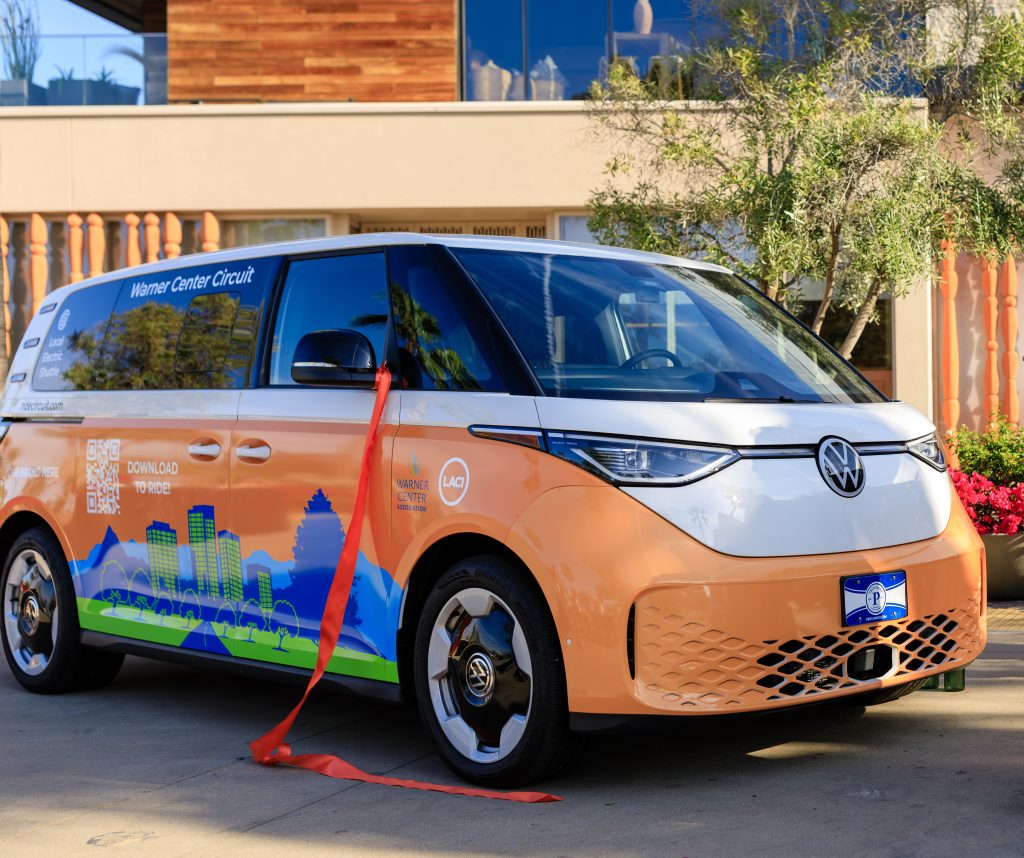
The Los Angeles Cleantech Incubator (LACI) and the Warner Center Association hosted a press conference and ribbon cutting Friday to formally launch an innovative microtransit pilot project at Warner Center in partnership with the Warner Center Association. The pilot, which is now operational in the Warner Center’s Transportation Technology Innovation Zone (TTIZ), will bring an all-electric shuttle service to the West San Fernando Valley.
The shuttles are provided by Circuit, a LACI portfolio company and a leading provider of electric, on-demand microtransit services.
Shuttles will be available for $1 per ride from 6 am to 8 pm on weekdays and 7 am to 9 pm on weekends within the geographic area of Warner Center. Theall-electric vehicle fleet includes GEM e6 six-seat electric shuttles, Volkswagen ID Buzz vans, and an ADA-accessible Ford E-Transit van.
“By launching this EV shuttle pilot here at Warner Center–a far reaching and bustling live-work community in the heart of the West San Fernando Valley–we have an opportunity to expand mobility access for the local residents, commuters, and visitors, while also showcasing the power of zero emissions solutions,” said Matt Petersen, President and CEO of LACI. “We are grateful for the support of Councilmember Blumenfield, Assemblymember Jesse Gabriel, and Senator Henry Stern for securing the funding that has allowed us to work with the Warner Center Association to deploy this innovative pilot.”
“Warner Center is exactly the kind of community where microtransit can make a real difference, and we’re proud to finally be up and running for the people who live and work here,” said Daniel Kramer, Vice President of Business Development (West) at Circuit. “This is just the beginning, and we look forward to growing with the community as Warner Center continues to evolve.”
This shuttle service launch is the first of two planned LACI Innovation Pilots in the bustling live-work Warner Center community.
Later this year, LACI will launch a second pilot that will deliver mobile EV charging robots provided by EV Safe Charge. These low-cost solutions will be available for residents, employees, commuters, and visitors alike–all while testing market-ready technologies ahead of wider rollouts.
During the launch event, local elected officials and community leaders voiced their support for this innovative solution:
“It’s not often that we have the opportunity to take a step together that has the potential to truly change the nature of our community,” said Brad Rosenheim, Chairperson of the Warner Center Association. “Today signifies one of those rare opportunities and I could not be more grateful to Councilmember Blumenfield, Supervisor Horvath, Assemblymember Gabriel, Sena-tor Stern, our partners at LACI and Circuit and the Warner Center Association Board of Directors for making this new transit opportunity possible.”
“As Warner Center has seen the largest growth in Los Angeles with residents, businesses, and visitors, this circulator is an exciting addition—making it easier, more affordable, and environmentally friendly for people to get where they need to go,” said Councilmember Bob Blumenfield.
“The Warner Center has been an important hub for innovation and economic growth in the West Valley,” Assemblymember Jesse Gabriel, Chair of the Assembly Budget Committee. “That’s why I’m proud to have secured $2 million in state funding to deliver clean, zero-emissions transportation options that will help reduce pollution and congestion in our community. I’m grateful to LACI and the Warner Center Association for their important partnership in this effort.”
The TTIZ serves as a hub for innovation where LACI seeks to invite zero emissions mobility, charging, and other solutions into a dedicated ‘innovation sandbox’ to better serve the needs of over 14,000 Angelenos who call Warner Center their home as well as the 45,000 people who work in the community. LACI and the Warner Center Association are piloting these transportation technologies in the TTIZ testbed following LACI’s merger with Urban Movement Labs in 2024.
The pilot is scheduled to run for an initial period of one year. Funding for the pilots comes from the State Legislature via the Governor’s Office of Business Development (GoBiz) and the Office of Councilmember Bob Blumenfield.