By Neill Simmons
The whole month of March brings us a brilliant Jupiter in all its glory. Look straight up to see the king of all planets after sunset. Four of Jupiter’s 95 known moons are visible through binoculars. These four moons – Io, Europa, Ganymede, and Callisto were discovered by Galileo in 1610, which provided early evidence for a sun-centered solar system.
On March 8, a Venus and Saturn conjunction will occur, with the two planets appearing very close together in the low western sky shortly after sunset. A conjunction occurs when celestial objects appear close to each other in the sky. This is an optical illusion caused by the observer’s perspective since the objects are usually millions of miles apart. Every night from now until September, Venus will be getting brighter and brighter each evening. Look west.
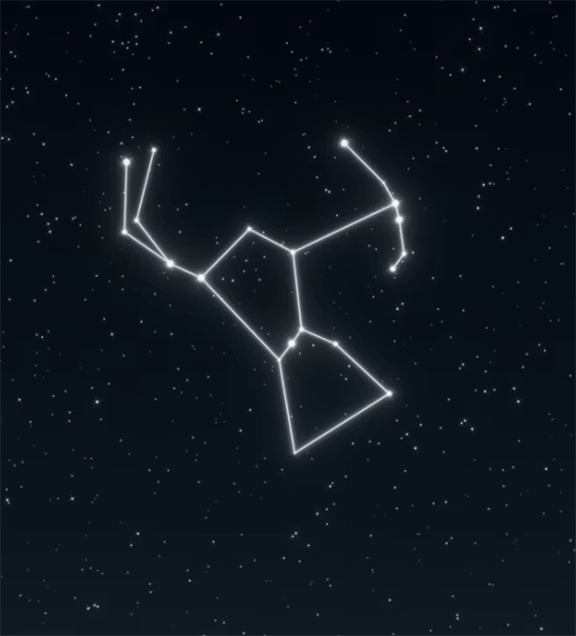
One of our favorite constellations, Orion the Hunter, will be shining in the west. Orion is best found by locating its “belt”made up of three bright, evenly spaced stars in a straight line. Look for the reddish star Betelgeuse which is Orion’s shoulder and the blue star Rigel which is his foot, to identify the full hunter constellation. In addition, look to the left of Orion to find the brightest star in the sky, Sirius, which is in the constellation Canis Major.
In March, the Big Dipper is a prominent feature of the spring night sky. Look northeast during early evening. It is now oriented “upside down” or standing on its handle. The Big Dipper is not a constellation. It is an asterism, which is a recognizable pattern of stars that is part of a larger constellation, Ursa Major. The most critical function of the Big Dipper is its role as a pointer to Polaris, the North Star. Polaris sits almost exactly above the North Pole. Once you find it, you will know which was is north, and consequently, east, west, and south.
When Elon Musk founded SpaceX his dream was to set up a colony on Mars. A lofty goal, mostly because we’ve really only sent rovers to take pictures of Mars. But now Musk wants SpaceX to change gears and instead colonize the moon. According to Musk, a city on the moon would take about 10 years to build. Don’t book your ticket just yet!
Mark your calendars! On Friday, March 13, at 7 pm, the Ventura Country Astronomical Society (VCAS) will host a free and open to the public lecture. The guest speaker will be Sarah Elizabeth McCandless, Navigation Engineer at NASA’s Jet Propulsion Laboratory. It will be held at the Hillcrest Center for the Arts in Thousand Oaks.
When not stargazing, Neill Simmons, is an Investment Executive with LPL Financial in Woodland Hills. If you have any astronomy or financial questions, he may be reached at (818) 936-2626 or emailed at: neill.simmons@lpl.com.