By Neill Simmons
The highlight of July is the return of one of the biggest constellations in the night sky – Scorpius. Look south after dark to spot the curved tail of the scorpion. Notice the bright red star towards the head of the scorpion. This red star named “Antares,” is the heart of the scorpion. Antares is over 700 times bigger than our Sun. If Antares replaced our Sun, it would extend all the way to Mars. Now that’s BIG! This Zodiac constellation has over 18 stars which can be seen with the naked eye.
Make plans to go to the “Night Sky Festival” on Saturday, July 26, at Paramount Ranch in Agoura Hills. This Star Party will be sponsored by the National Park Service and the Ventura County Astronomical Society. There will be many telescopes set up for viewing with astronomy guides to answer your questions. This is a FREE event. Make sure to get there by 7 pm to enjoy all the activities that are planned. Parking is plentiful and free.
The planet Mars is visible in the west this month and sits in the constellation of Leo the Lion. On Monday the 28th, the crescent Moon will appear close to Mars, which is a nice sight to see. Scientists say a mysterious giant cloud hanging over the surface of Mars, which was first spotted in 2018, has recently reappeared on the Red Planet. Made of water and ice, the elongated cloud sits 12.4 miles above the volcano Arsia Mons and stretches some 1,110 miles in length. Scientists have named the formation the “Arsia Mons Elongated Cloud” (AMEC). However, experts are not clear why it has formed, how long it will stay or when it will disappear from the Martian atmosphere.
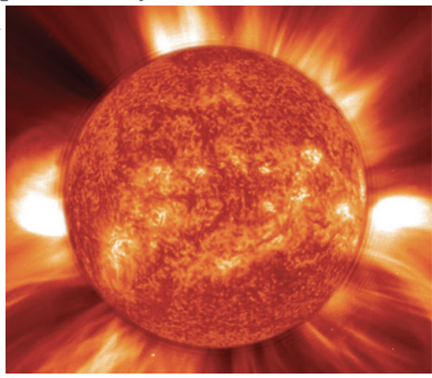
NASA has warned that the Sun will be very active in July. There will be several Coronal Mass Ejections (CME) which will create auroras in the night sky. Chances to see an aurora increase the farther north you travel. A CME is a powerful eruption of plasma and magnetic field from the Sun’s upper atmosphere, or corona. CMEs can eject billions of tons of material and travel at speeds of up to 1,800 miles per second.
Three sights to see without a telescope in July are: The Big Dipper which is hanging straight down by its handle. The fifth brightest star, Vega, is in the northeast. The Summer Triangle, which is an asterism, or pattern of stars, that’s made up of three bright stars from three different constellations. Vega is one of these stars from the constellation Lyra.
The planet Venus is bright in the early morning sky from 3:30 am until dawn. Look on Thursday, July 3, with binoculars to see Uranus in the same field of view as Venus. Uranus has faint rings made of dust and ice, with the inner rings being narrow and dark, and the outer rings being brighter and easier to see. Uranus has 28 known moons and Venus has no moons.
The full Moon in July is called the Buck Moon because the antlers of male deer (bucks) are in full-growth mode at this time. The name is thought to come from Native American culture. This full Moon will occur on Thursday, July 10. The Moon is a rocky body made up of iron, magnesium, aluminum, silicon, titanium, gold, silver, and mercury.
As summer vacation starts, make sure to get away from the city lights to see the Milky Way in the south, the Little Dipper in the north. Earth is located on one of the spiral arms of the Milky Way galaxy. Looking out at the Milky Way is actually looking to the center of the galaxy. It is estimated that there are over 300 billion stars within our galaxy. The Little Dipper, also known as Ursa Minor, is a constellation in the northern sky. The Little Dipper is made up of seven stars, but only three are bright enough to see in the night sky, and the others are only visible in very dark skies. One of these stars is Polaris, also known as the North Star. This star is located at the end of the Little Dipper’s handle and is very important because it doesn’t appear to move and helps orient people in the direction of north. The closest dark skies are at the beaches north of Malibu or the area around Mt. Pinos which is about an hour’s drive away.
When not stargazing, Neill Simmons, is an Investment Executive with LPL Financial in Woodland Hills. If you have any astronomy or financial questions, he may be reached at (818) 936-2626 or neill.simmons@lpl.com.