By Neill Simmons
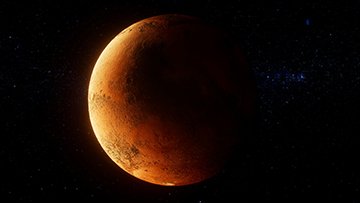
The highlight of January is the red planet, Mars, returning to our early night sky. Look low in the east to spot the planet. This will be visible with your naked eye. On Monday, the 13th, at 6 pm, the full Moon will cover Mars for approximately one hour and will reappear at 7 pm. This is an interesting and rare astronomical event called an occultation. However, it may be difficult to spot Mars because of the Moon’s bright glare. Mars will be at its peak brightness on Wednesday, the 15th. During the month, Mars will move position from the constellation of Cancer into the constellation of Gemini. Viewed through binoculars, the white polar caps of Mars may be visible.
The Quadrantids Meteor Shower is considered among the top annual meteor showers and it peaks between January 3 and 4. During peak activity and under favorable conditions, this shower can produce about 100 shooting stars per hour. During the peak, the Moon will be only 11% illuminated which will make it easier to see the meteors.
Venus is still the brightest object in the night sky. Look westward. Early in the month, Venus and the Moon will appear to be very close together. This will be a dazzling sight. On Sunday, the 19th, Venus will be joined by Saturn in the west. Venus is the second brightest natural object in the night sky, after the Moon. It’s often called the Morning Star or Evening Star because it’s so visible in the morning and evening. It is the hottest planet in our solar systems with a surface temperature of about 900 degrees Farenheit.
The planet Jupiter has been outstanding in brightness and is overhead in January. Look on Friday, the 10th, when the Moon and Jupiter appear very close together. Jupiter is the largest planet in our solar system, more than twice as massive as all the other planets combined. It’s so big that over 1,300 Earths would fit inside it! Jupiter is the fastest spinning planet in our solar system, with a day lasting just under 10 hours. It is a gas giant made up of mostly hydrogen and helium, the same elements as our sun.
The first full Moon, the Wolf Moon, occurs on January 13. It is thought that January’s full Moon came to be known as the Wolf Moon because wolves were more likely to be heard howling at this time. It was traditionally believed that wolves howled due to hunger during winter, but we know today that isn’t accurate. Howling and other wolf vocalizations are heard in the wintertime to locate pack members, reinforce social bonds, define territory, and coordinate hunting.
At this time of the year, the Winter Hexagon is visible. The Winter Hexagon is not a constellation but an asterism which links the six brightest stars in each of six major constellations. The six stars are among the brightest in the northern hemisphere sky and why this formation is able to be identified despite its coverage of a large section of the sky. It links the stars of Rigel (Orion), Sirius (Canis Major), Procyon (Canis Minor), Pollux (Gemini), Capella (Auriga), Aldebaran (Taurus). It is considered one of the easiest formations to identify as it includes four of the eight brightest stars visible in the night sky.
Mark your calendars for Saturday, January 4. Griffith Park Observatory will be having their monthly Star Party on the front lawn from 2 pm until 9:45 pm. There will be telescopes available with guides to explore the sky. This event is FREE!
When not star-gazing, Neill Simmons is a Wealth Advisor with LPL Financial in Woodland Hills. If you have any astronomy or financial questions, he may be reached at (818) 936-2626 or email at neill.simmons@lpl.com.