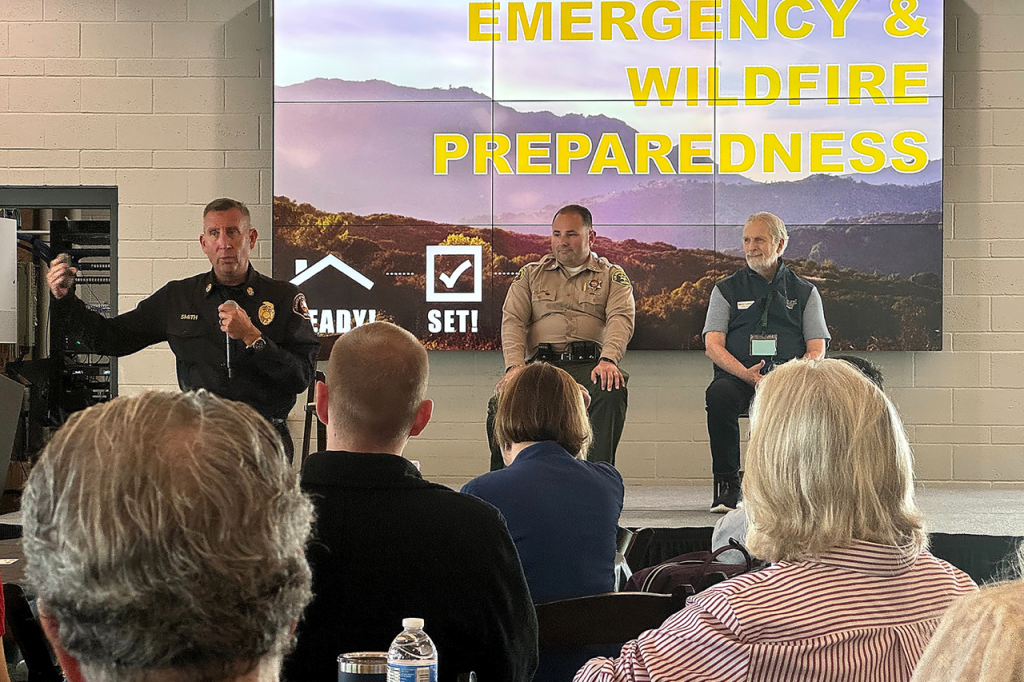
More than 150 regional Firewise community leaders, including volunteers from EPIC-FSC (Emergency Preparedness in Calabasas – A Fire Safe Council) and wildfire mitigation experts from the City of Calabasas, gathered for a Regional Firewise Workshop. The goal was to strengthen community-level wildfire preparedness and educate and empower Firewise leaders across the entire region.
Co-hosted by the Calabasas Firewise Team, and the Santa Monica Mountains Fire Safe Council, the event brought together a diverse group of fire safety professionals, public officials and engaged resident leaders committed to reducing wildfire risk through coordinated action. Attendees heard from regional leaders and left with practical tools, actionable strategies, and valuable insights they can bring back to help strengthen wildfire preparedness in their own communities.
Mike Dyer, the Public Safety Manager for the City of Calabasas, played an important role. “This regional event brought together stakeholders and Firewise leaders from Los Angeles to Santa Barbara,” said Mike Dyer, former Chief Deputy with the Los Angeles County Fire Department and retired Fire Chief of the Santa Barbara County Fire Department. “Approximately 70 to 80 Firewise leaders and about 50 industry stakeholders attended, along with Fire Safe Council representatives and leading companies in fire technology, GIS, and fire prevention and suppression.”
Calabasas Firewise is a community-driven initiative that helps residents reduce wildfire risk and strengthen neighborhood preparedness. Fire Safe Councils are grassroots, community-led organizations that mobilize residents to protect their homes, communities, and surrounding environments from catastrophic wildfires. In Calabasas, these efforts include promoting defensible space, home hardening, and improved coordination among residents and fire-related agencies.
“The level of engagement we saw today is exactly what’s needed,” said Brian Cameron, EPIC-FSC’s president. “Wildfire preparedness is most effective when communities come together, share knowledge, and act at the neighborhood level. That’s how we create real, lasting impact.”
Throughout the day, speakers and participants focused on practical, actionable strategies to help neighborhoods build resilience. Key topics included home hardening, defensible space, vegetation management, and the process of establishing and maintaining Firewise communities. Attendees also explored how neighborly collaboration is critical to reducing risk at scale—an approach widely recognized as one of the most effective ways to protect homes in fire-prone areas.
Peter Fehler, CWMS, a wildfire mitigation consultant and one of the event organizers, emphasized the need to translate awareness into action. “This workshop is about equipping people with the tools and confidence to take action,” he said. “The more communities that step up to become Firewise, the stronger and more resilient our entire region becomes.”
The workshop, sponsored by L.A. County Supervisor Lindsey P. Horvath, who represents the Third District, featured a distinguished lineup of speakers from across government, fire services, policy, and consumer advocacy.
Michele Steinberg, Wildfire Division Director at the National Fire Protection Association, shared national insights on wildfire mitigation and community preparedness. A driving force behind the Firewise USA® program since 2002, she highlighted how organized, neighborhood-level action can significantly reduce wildfire risk and help prevent the loss of homes and communities.
Fire Chief Anthony C. Marrone of the L.A. County Fire Department addressed the scale and complexity of wildfire response across the region. As the leader of one of the country’s largest metropolitan fire departments, Chief Marrone oversees services for more than 4.1 million residents in 60 cities and 120 unincorporated areas, underscoring the importance of preparedness at both the agency and community levels.
Assistant Fire Chief Drew Smith offered insight into fire behavior, fuel management, and operational strategies across diverse terrain, including the Santa Monica Mountains and surrounding communities. Drawing on decades of experience in wildfire response and risk assessment, he emphasized the importance of proactive planning and interagency coordination.
Captain Dustin Carr of the L.A. County County Sheriff’s Department offered a law enforcement perspective, emphasizing public safety, evacuation coordination, and the importance of communication among agencies and with residents during wildfires.
Amy Bach, Executive Director and co-founder of United Policyholders, addressed the often-overlooked role of insurance in wildfire recovery. A nationally recognized consumer advocate, she offered guidance on preparedness from financial and policy perspectives, helping residents better understand coverage, claims, and long-term recovery considerations. The insurance panel brought together influential voices across the industry, including Julia Svetlana Juarez, Deputy Insurance Commissioner for Community Relations and Outreach, and Victor Joseph, President and COO of Mercury Insurance. The workshop underscored a central message: Wildfire preparedness is not just an individual responsibility—it is a community effort. When neighborhoods organize, share resources, and adopt Firewise principles, their collective ability to withstand wildfires increases significantly.
The strong turnout reflects growing awareness across the region as wildfire seasons become longer and more intense. Leaders emphasized the need to build momentum now to increase the number of recognized Firewise communities throughout the area and to educate the public.
The message of the day was clear: Wildfire preparedness starts at the neighborhood level, and the most effective protection comes from communities working together.