San Fernando Valley-based writer Paul Pumpian has a theory about films: If you really enjoyed a movie, don’t see it more than twice. In his cinematic catechism, if you do, you’re sure to see the flaws or continuity issues you missed in the first two viewings, and that will diminish your love for that film.
Every film lover knows the complexities of filmmaking, the time frames (often months) over which they are shot, and the hundreds of people (onscreen and off) who are involved, make bloopers or other errors nearly inevitable. But that doesn’t diminish the fun in spotting them.
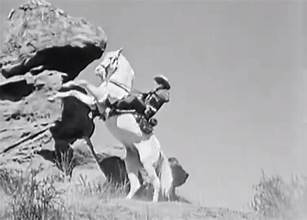
Take, for example, 1939’s Stagecoach, one of the best Westerns ever, and shot partially on the Iverson Ranch in Calabasas and the RKO Studio Ranch in Encino. According to Pumpian, “Before the film’s gun fight conclusion, there are two occasions where the travelers pull into resting places; in both, the stand-in stagecoach driver is a much thinner man than the much-more-portly Andy Devine, who drives the stage throughout the film.
“In Stagecoach there’s a great deal of drinking, but not once is alcohol paid for. The boozy doctor is in the town saloon when he gets a free drink from the bartender. When the stagecoach is at its second rest stop, there is more drinking, but no paying. The same is true at the film’s final saloon scene, where the villain and the doctor down shots.”
Finally, Pumpian points out, during the classic chase scene, several of the Indians ride alongside the stagecoach without shooting arrows into the horses, an act that would have ended the chase. The first arrow that hit Donald Meek was an incredible shot, because the sound of the approaching Indians was still far behind the coach when it nailed him.
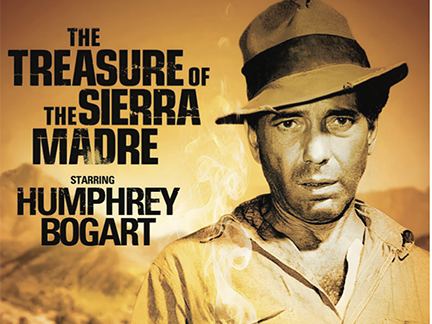
Pumpian’s second example is that classic, The Treasure of the Sierra Madre (1948), also partially filmed on the Iverson Ranch, as well as the Warner Bros. Burbank lot: “To disguise their intent of searching for gold, the three men head into the Sierra Madre on the pretext of being hunters, armed primarily with pistols. You can’t do much successful hunting with pistols, but at the film’s conclusion, the trio has amazingly accumulated numerous bundles of animal fur.
“Gold Hat’s sombrero is missing the bullet hole that Bogart shot into it at the mountain confrontation previously. During the cantina fight with McCormick, the position of Dobbs’ hat on the bar rail changes at least twice.
“When Howard is laid on a hammock, being served by Indian women, he has a little bunch of flowers on his left ear which disappear in subsequent shots.”
Pirates of the Caribbean: The Curse of the Black Pearl (2003) was partially filmed on two Valley studio lots, Disney and Universal. The keen-eyed will spot a number of “goofs,” as IMBb.com calls them. When Barbossa is shouting commands while chasing the Interceptor, in one shot his teeth are perfectly white, while in the rest of the movie they are decayed.
When Will Turner first shows up in the movie bringing the sword to Governor Swann, Turner is almost clean shaven; in the next scene, which occurs on the same day, he has a little goatee and almost full mustache.
Early in the film, when Jack Sparrow is standing on the sail of his sinking boat, he prepares to step onto the dock by raising and extending his right foot. The next shot shows his left foot taking the first step.
During a shot of Jack Sparrow at the helm, the keen-eyed will spot a crew member in a T-shirt and cowboy hat at the far edge of the frame.
A fourth example is Harry Potter and the Chamber of Secrets (2002). Much of the film was shot at Warner Bros.’ studio in Leavesden, England.
The errors are nearly too numerous to recount. For example, when the bludger hits Harry’s hand in the Quidditch scene, his arm guard is shown flying off his arm; the next time his arm is shown, the arm guard is still there.
While Harry and Draco are dueling, a camera operator is clearly reflected in the glass behind them. In another dueling scene, Professor Lockhart is knocked backwards by Professor Snape’s charm, and his wand can be seen flying through the air. When he lands, however, the wand is still in his hand.
Nearly every film has these miscues or other issues. However, I’d still watch Stagecoach, The Treasure of the Sierra Madre, Pirates of the Caribbean: The Curse of the Black Pearl, and Harry Potter and the Chamber of Secrets, any time they show up on the large screen, because these are films too “big” to be viewed on an in-home monitor, no matter how large.
Martin Cooper of Cooper Communications supervised public relations for the Academy of Motion Picture Arts & Sciences for 10 years.
His next book, The ‘Reel’ Hollywood: The San Fernando Valley, the history of motion pictures in the Valley, will be out later this year.