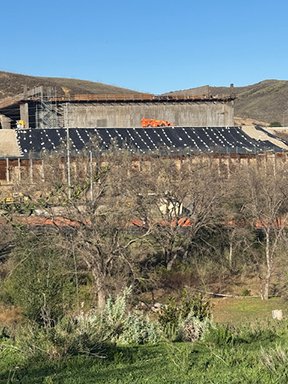
With the devastation from the Palisades Fire an ongoing issue, and the memory of the Woolsey Fire jumping the 101, concerns have been raised by local residents about the wildlife bridge under construction.
The so called “fuzzy” overpass will be a planted corridor from the north side of the 101 over the freeway and Agoura Road into the mountain on the south side to allow wildlife to safely traverse the freeway.
Will this enable fire to more easily jump the freeway?
“Not at all,” said Robert Rock of Rock Design Associates, the landscape architecture and environmental planning firm responsible for the design of vegetation for the bridge.
The top of the bridge will be covered in almost an acre of native plants.
Living Habitats, with the help of Caltrans and the National Park Service, has collected seeds, acorns and mushrooms and built a special project nursery off Las Virgenes Road to germinate them for landscaping the new bridge.
“Right now what covers the slopes is non-native mustard, which is more of a fire risk than what we are planting,” explained Rock. Ten acres along the two sides of the bridge will be improved by site grading, removing the invasive species and replanting.
The landscape design will blend the bridge vegetation into the adjoining slopes for a cohesive look that will, to an extent, camouflage the bridge and make it more part of the natural landscape
Additionally, said Michael Comeaux, Public Information Officer at Caltrans, there will be a sprinkler system across the bridge to provide water for the landscape and wildlife, which can also be activated during a fire.
The native vegetation will, according to the Essential Habitat Connectivity Project, also reduce greenhouse gases by the preservation of biodiversity in the Santa Monica Mountains.
Comeaux says fire safety is part of any Caltrans project, and they have determined that the crossing poses no additional risk in terms of wildfire spread. Caltrans also has buried the electrical lines for the project underground, which additionally reduces fire risk.
He also pointed out that the Woolsey Fire skipped over the 101 all on its own at the bridge site, so “you don’t need the crossing for a fire to jump the freeway.”
Lauren Gill, Deputy Director of savethecougars.org, a cam-paign of the National Wildlife Federation, said that animals are already taking note of the bridge.
“We were out there one night inspecting, and a huge owl swooped over us crossing the bridge,” she explained excitedly. “It’s the one stretch of dark across the freeway, and animals are naturally drawn to it.”
When finished, the Wallis Annenberg Wildlife Crossing will be the largest of its kind in the world. Construction is anticipated to finish in early 2026.