By Neill Simmons
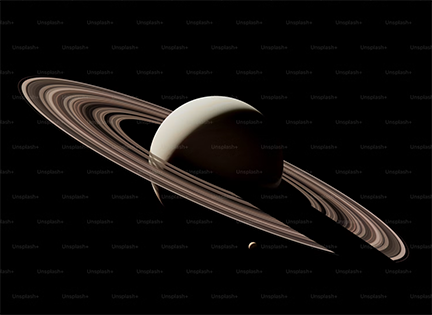
The highlight of September is the return of the ringed planet Saturn. After 9 pm look east to see the planet rising. Saturn will be at its brightest on Saturday night, the 20th. At this time of the year, Saturn is between the constellations Pisces and Aquarius. In October, Saturn will be fully in Aquarius. It takes over 29 years for this planet to orbit the Sun. If you have binoculars, one of Saturn’s moons, named Enceladus, can be spotted. Saturn is not a perfect sphere as its north pole is 90% of the equatorial diameter. Saturn’s winds blow at over 1100 miles per hour, the fastest in the solar system. One day on Saturn is just over 10 hours long. Look on Monday, the 8th, when the Moon and Saturn will appear to be close to each other.
The full Moon on September 7 is called the “Corn Moon.” This name comes from Native American traditions, as corn was often harvested at this time of year. It is also sometimes called the “Autumn Moon.” If you are traveling to Asia, Australia, or parts of Europe and Africa, the full Moon will appear red due to a Total Lunar Eclipse. This is also known as a “Blood Moon.” Unfortunately, the lunar eclipse will not be visible in the Americas.
Mars is low in the west in September and appears as a tiny red spot. On Wednesday, the 24th, Mars will be near the thin crescent Moon. Mars is known as the “Red Planet” due to the iron oxide in its soil. It has the largest volcano and canyon in the solar system. It has two moons, Phobos and Deimos, and its seasons are similar to Earth’s but much longer.
Dawn Patrol: The planets Jupiter and Venus are a great sight in the east after 4 am until dawn, which is about 5:30 am. Both are super bright with Jupiter appearing to be above Venus. To the right of Jupiter is the Orion constellation.
On Sunday afternoon, September 21, there will be a partial solar eclipse, which will cover about 10% of the Sun. It should only be seen with good eclipse glasses! Next year, on August 12, 2026 there will be a solar eclipse in Greenland, Iceland and Spain lasting about two minutes. This is the first mainland eclipse in Europe since 1999. Also, many people are making plans now for the August 2, 2027 solar eclipse. It will last over six minutes and 21 seconds long. It starts in the Atlantic Ocean and goes through Gibraltar, Egypt and parts of Africa. There will be many cruise ships traveling to this event.
Every night, look straight up to see the famous asterism, the “Summer Triangle.” The three stars that make up this formation are called Vega, Deneb, and Altair. An asterism is a recognizable pattern or group of stars that is not an officially designated constellation. Another asterism in the same area is the “Northern Cross” which is located within the constellation Cygnus the Swan. Also, the dwarf planet Pluto is in the center of this asterism but cannot be seen with the naked eye. Pluto is primarily known as the largest dwarf planet in our solar system and for the controversy surrounding its demotion. It was once considered the ninth planet but was reclassified in 2006 due to new definitions of a planet.
The next two months will bring us a lot of solar activity with some spectacular auroras. Most of the action will be above Bakersfield and all the way to Canada. The Aurora Borealis, or northern lights, are natural light displays in the sky caused by charged particles from the sun colliding with Earth’s upper atmosphere. We are hoping one might show up here in Southern California.
Another great sight to see in September is our spiral galaxy, the “Milky Way.” It is bordered by Sagittarius on the left and Scorpius on the right in the west. It is best to get out of the city lights to see the band of stars.
In the East, the Great Square of Pegasus, the Winged Horse, is a large, prominent asterism in the autumn night sky, composed of four bright stars that form a square or diamond shape. Notice that the square is balanced on one corner and in the square there are no stars visible. The Great Square serves as a guide for astronomers to locate other celestial objects, most notably the Andromeda galaxy.
Mark Saturday, September 13, on your calendar as a fun and local “star party” will come back to Paramount Ranch. The Ventura County Astronomical Society is putting on “An Evening Under the Stars” with many telescopes and special events. You can also bring your own telescope. The location is in Agoura Hills and there is plenty of room to park. It starts at 7:30 pm but get there before dark to take full advantage of the evening. Night temperatures can be chilly so dress accordingly. This event is free.
When not stargazing, Neill Simmons is an Investment Executive with LPL Financial in Woodland Hills. If you have any astronomy or financial questions, he may be reached at (818) 936-2626 or emailed at: neill.simmons@lpl.com.